

Planning cross-border logistics? Providing a precise and fully detailed Commercial Invoice represents the most effective way to ensure a seamless and rapid customs clearance process. Here, Marcelo Godoy Rigobello, DHL Express’ Global Trade and Customs Compliance Expert, breaks down the reasons why high-quality (i.e. complete and accurate) data remains absolutely critical—and offers actionable strategies for success.
Every day, thousands of SMEs – and corporate operations of all sizes – rely on DHL Express to transport their shipments to global buyers quickly and efficiently. However, you might find it unexpected to learn what stands as a primary barrier to execution. It’s not border closures, labor shortages, or even severe weather…the culprit is flawed paperwork.
Commercial entities exporting internationally with DHL Express are required to submit their Commercial Invoice information electronically. Unfortunately, flawed or missing details – such as an ambiguous Goods Description – can cause severe operational disruptions. It means your shipment risks being delayed by Customs Authorities until the issue is resolved – and this can create naturally creates a negative chain reaction for your consumer base, who may receive their goods late.
Ultimately, maintaining immaculate data standards is so important, that it stands as a fundamental recommendation we emphasize to any business shipping internationally with DHL Express.
Understanding the Role of a Commercial Invoice
This essential document supplies specific insights regarding merchandise transported across international borders. It outlines an exhaustive breakdown of the cross-border transaction, including:
Full names, physical locations, and contact data for both the sender and recipient
Tax or corporate identification figures, where required
A thorough breakdown of the items
Harmonized System (HS) Code, preferably the complete Tariff Classification Code
Country of Origin
Declared monetary value and specific currency used
Weight & Quantity
The underlying purpose of the transfer
Logistics specialists utilize these details to prepare the Customs Declaration for border control authorities, who subsequently evaluate whether the cargo satisfies regulatory frameworks (i.e., whether it is safe, legal, and compliant) These specifications also allow fiscal agents to calculate the taxes and duties due.
So, what does Good Data Quality mean in practice?
Maintaining flawless and precise digital inputs on the Commercial Invoice is critical. Among others, the following points demand your utmost precision.
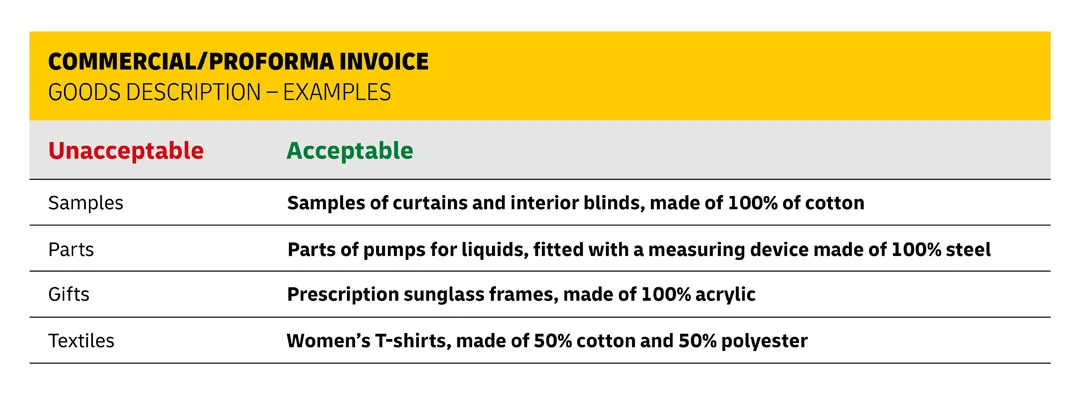
1. The Goods Description really matters
A primary objective of this breakdown is to help customs authorities identify prohibited/restricted goods, while executing precise risk profiling for safety and security reasons. Regrettably, many exporters fail to supply sufficient clarity at this stage. Vague entries like “samples” or “parts”, for example, fail to provide an acceptable description. Under these circumstances, DHL is forced to halt the cargo and contact the consignee to clear up the ambiguity—a process that invariably disrupts the transit timeline and harms the buyer's journey.
An explicit, precise, and granular inventory of every transported article remains mandatory for swift clearance. In addition to these breakdowns, shippers should also provide the corresponding Tariff Classification Code. DHL’s MyGTS (My Global Trade Services) tool can help businesses pinpoint accurate matches for the Export and Import Tariff Codes of their goods.
2. Goods value: be honest and accurate, or risk delays at customs
When completing your paperwork, you must state the exact financial value of every article in the consignment – this typically reflects the actual amount transferred from the purchaser to the vendor (along with the corresponding currency), fully conforming to WTO Customs Valuation rules. Border control agencies rely on this figure to determine the precise duties and taxes that apply.
Some shippers are tempted to understate item value, an unlawful practice that carries severe repercussions. For example, authorities may detain the cargo, demand proof of the figures you reported, and enforce immediate payment for any outstanding tariffs, along with substantial fines. They may even contact the recipient – meaning your final consumer – for this verification, severely harming your brand's reputation.
Furthermore, authorities in certain countries may treat deliberate under-declaration as a criminal offense of tax evasion, triggering heavy penalties, monetary assessments, and strict judicial actions. For this reason, it is vital to maintain complete honesty regarding the figures entered into the document, including any supplementary financial factors that influence the total assessable value, such as protection coverage, transport fees, or related expenditures.
3. Ensure compliance with regulations
Border regulations differ significantly across jurisdictions, creating potential friction for cross-border operations – especially when managing multiple global routes. Before dispatching a cross-border consignment, exporters must perform comprehensive due diligence to understand the primary outward mandates of the native country, the entry criteria of the destination territory, or consult directly with professional legal counsel.
To streamline this process, merchants can leverage DHL’s MyGTS (My Global Trade Services). This free, user-friendly platform is designed to help SMEs navigate international shipping regulations – including detailed case models of regional border frameworks that could affect your business.
Submitting fully comprehensive, flawless data on your paperwork represents a foundational requirement for securing frictionless border clearance and protecting the buyer's post-purchase journey.
"Regulatory Authorities across the globe are moving towards a fully data-driven environment to enable efficient and risk-based clearance processes. Complete & accurate Commercial/Proforma Invoice line item data is the key enabler for fast & compliant clearance processes, avoiding delays, fines & penalties." - John Pearson, CEO DHL Express
How to complete a Commercial Invoice: A step-by-step guide
- Filling out error-free paperwork documentation remains critical to securing fast international shipping. Our comprehensive international express carrier protocols are designed to steer your business through each section of this requirement, ensuring the data you submit is clear, accurate and complete.
- By adhering closely to these directions, you can prevent operational friction caused by incorrect or omitted information, such as:
Costly border holding times where your freight is stranded in local storage facilities.
Redundant support outreach to collect forgotten transaction variables.
Consignments blocked, rejected, permanently seized, or subjected to heavy regulatory fines by customs authorities.
DHL Express makes every effort to ensure that information from external sources is accurate at the time of publishing. However, details from outside agencies can change without notice. Please read our disclaimer here.


 Share
Share

Similar Stories