#LogisticsAdvice


 Share
EU Customs Changes 2026: New €2 Handling Fee & Product Identifier Requirements from 1 November
Share

Shipping goods to the European Union (EU)? Two important customs changes taking effect on 1 November 2026 will impact businesses selling directly to EU consumers.
As part of the EU Customs Reform, exporters must prepare for a new €2 EU Handling Fee and mandatory Product Identifier (PID) requirements for Business-to-Consumer (B2C) shipments entering the EU's 27 member states.
These changes affect businesses in Thailand and other non-EU countries, regardless of shipment value. Understanding the requirements early can help businesses manage shipping costs, prepare accurate customs documentation and avoid unnecessary clearance delays.
Here's what exporters need to know and how to prepare.
What Are the New EU Customs Changes from 1 November 2026?
Two key regulatory changes will affect B2C shipments imported into the EU:
- €2 EU Handling Fee A mandatory €2 fee per import customs declaration line item, regardless of shipment value.
- Product Identifier (PID) Mandatory product identification data must be provided for each applicable line item to support EU customs clearance.
Both requirements apply to B2C goods shipped from outside the EU to consumers across the EU27.
These are EU regulatory requirements, not DHL Express-specific requirements, and apply across express carriers.
1. EU Handling Fee: What Exporters Need to Know
From 1 November 2026, a mandatory €2 EU Handling Fee will apply per import customs declaration line item for B2C shipments entering the EU, regardless of the goods' value.
The fee is intended to help cover the increasing costs of customs supervision and processing as international e-commerce shipments continue to grow.
How is the €2 EU Handling Fee calculated?
The fee is calculated based on import customs declaration line items, rather than simply the number of parcels or individual product units.
For example:
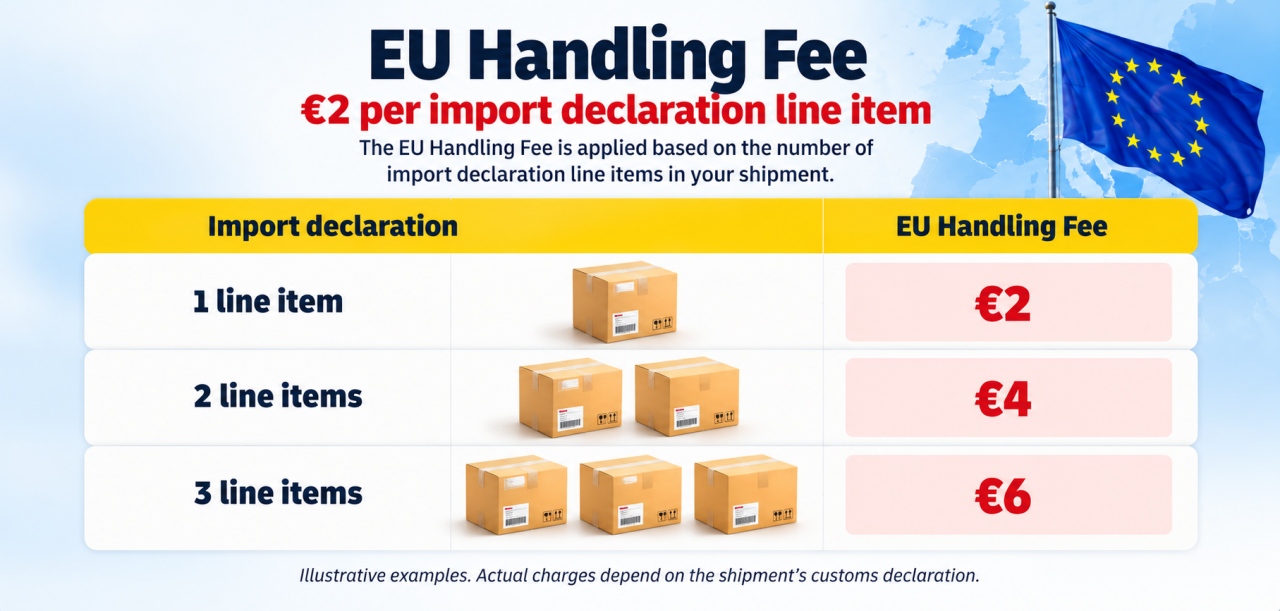
Important: The EU Handling Fee is a mandatory regulatory charge imposed under EU legislation. It is not a DHL Express service fee.
Is the €2 EU Handling Fee the same as the €3 customs duty?
No. These are two separate charges.
Since 1 July 2026, the EU has applied a €3 customs duty per applicable declaration line item on low-value B2C imports valued at €150 or less, replacing the previous customs duty exemption.
From 1 November 2026, the additional €2 EU Handling Fee will apply to B2C shipments regardless of shipment value.
Applicable customs duties, VAT and other charges may also apply depending on the shipment.
Who pays the EU Handling Fee?
For shipments handled by DHL Express, the party responsible for paying the fee depends on the selected DHL Duty Billing Service.
DTP – Duty Tax Paid
The shipper pays the applicable import duties, taxes and customs-related charges, including the EU Handling Fee.
DTU – Duty Tax Unpaid
The importer or receiver in the EU is responsible for paying the applicable import duties, taxes and customs-related charges, including the EU Handling Fee, before delivery.
Businesses should communicate these payment arrangements clearly to customers to help avoid unexpected charges or delivery delays.
2. Product Identifier (PID): Mandatory Information for EU Customs Clearance
The second important change concerns the information businesses must provide when shipping goods to EU consumers.
From 1 November 2026, Product Identifiers (PIDs) become mandatory at the line-item level for B2C imports into the EU27, regardless of shipment value.
What is a Product Identifier (PID)?
A Product Identifier is a unique alphanumeric code used to identify a specific product throughout the supply chain.
It enables EU Customs authorities to identify products more accurately, support product traceability and assess compliance with EU requirements.
The regulation is intended to strengthen consumer protection and help customs authorities identify potentially unsafe or non-compliant goods entering the EU.
Which Product Identifiers are required?
Businesses should prepare the following product information:
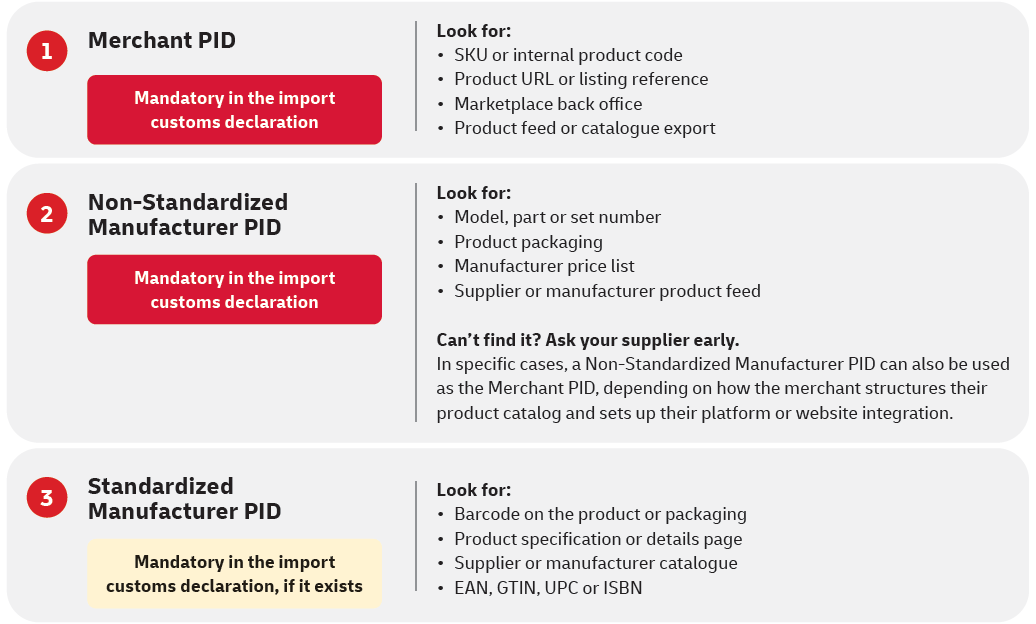
For example, an online seller exporting electronic accessories to Germany may need to provide the product's SKU, manufacturer model number and relevant barcode identifier, where available.
Businesses can usually find these codes in their product catalogues, supplier documentation, product packaging or e-commerce platform records.
What happens if a Product Identifier is missing?
Incomplete or incorrect PID information may prevent customs authorities from processing the import declaration.
This can result in:
- Customs clearance delays
- Shipment holds at the EU border
- Potential return to origin
Important: Product Identifiers are mandatory EU regulatory data requirements applicable to all express carriers, not requirements introduced by DHL Express.
How Can Thai Exporters Prepare for the New EU Customs Rules?
To help ensure smoother shipping and customs clearance, businesses should take the following steps before 1 November 2026.
1. Review your product information
Check that each product has the required Merchant PID and Manufacturer PID information. Request missing product identifiers from suppliers where necessary.
2. Submit Product Identifiers electronically
Provide complete and accurate PIDs at line-item level when creating shipments through DHL Express Electronic Shipping Solutions, such as MyDHL+.
3. Ensure accurate customs documentation
Provide complete product descriptions, accurate declared values, applicable HS codes and Commercial or Proforma Invoice information electronically.
4. Confirm the correct receiver details
Include the importer's or receiver's correct name, email address and mobile phone number to support efficient customs processing.
5. Review import charges and billing arrangements
Understand how the €2 EU Handling Fee affects your shipping costs and confirm whether duties and taxes will be paid by the shipper or receiver.
Taking these steps can help reduce the risk of customs clearance delays and unexpected costs.
Ship to the EU with Confidence with DHL Express
Keeping up with changing international trade regulations can be challenging, especially for businesses expanding into overseas markets.
With DHL Express, you can access international shipping expertise, customs guidance and electronic shipping solutions to help prepare your shipments for import and export requirements.
Whether you're shipping to the EU for the first time or managing regular international orders, our specialists are here to support your business.
Open a DHL Express Business Account to connect with our shipping specialists, stay informed about important regulatory updates and receive guidance on your international shipping needs.
Disclaimer: Regulatory information is subject to change. Import duties, taxes, fees and customs requirements may vary depending on the shipment and destination. Please consult the relevant EU authorities or DHL Express for further guidance.
Share
Similar Stories