The K1 and K2 Forms, also known as Borang Kastam K1 and Borang Kastam K2, are specific shipping documents used in Malaysia to declare goods imported into and exported from Malaysia. This form is required by the Royal Malaysian Customs Department (RMCD) for the accurate calculation of duties and to verify adherence to import and export regulations.
Malaysia has several customs declaration forms, including K3, K8, and K9. Each of these forms has its own unique purpose in the customs process, ensuring that goods are declared and cleared according to the regulations.
In this article, we will explain everything you need to know about the K1 and K2 forms when it comes to international shipping in Malaysia.
What is K1 Form
There are different K1 forms in Malaysia - one issued by the Jabatan Pengangkutan Jalan for vehicle registration, and the Customs K1 (Borang Kastam K1), used by the Royal Malaysian Customs Department for import declarations.
This guide focuses on the Customs K1, explaining its role in declaring and processing imported goods in Malaysia.
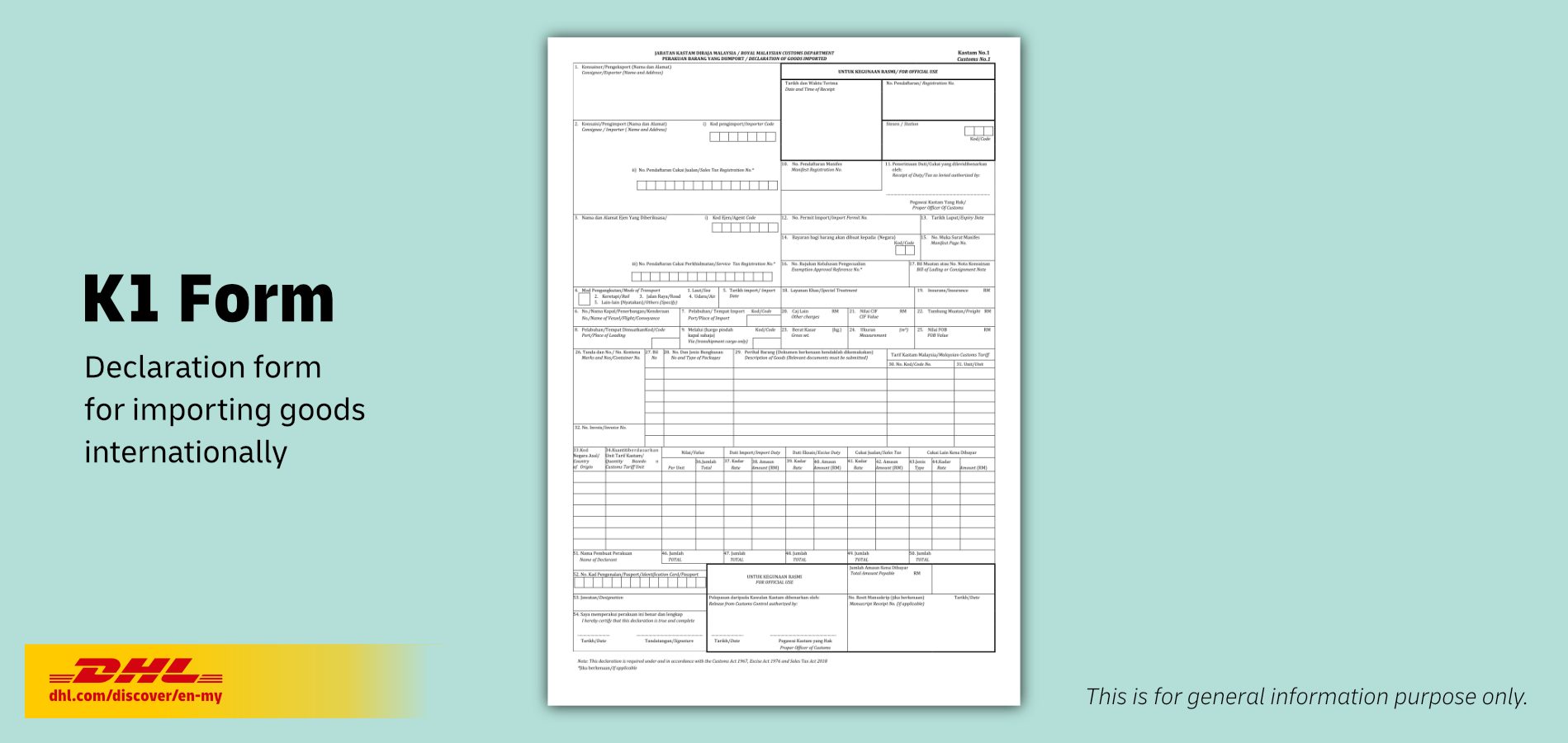
The K1 form is a mandatory customs declaration for all imported goods.
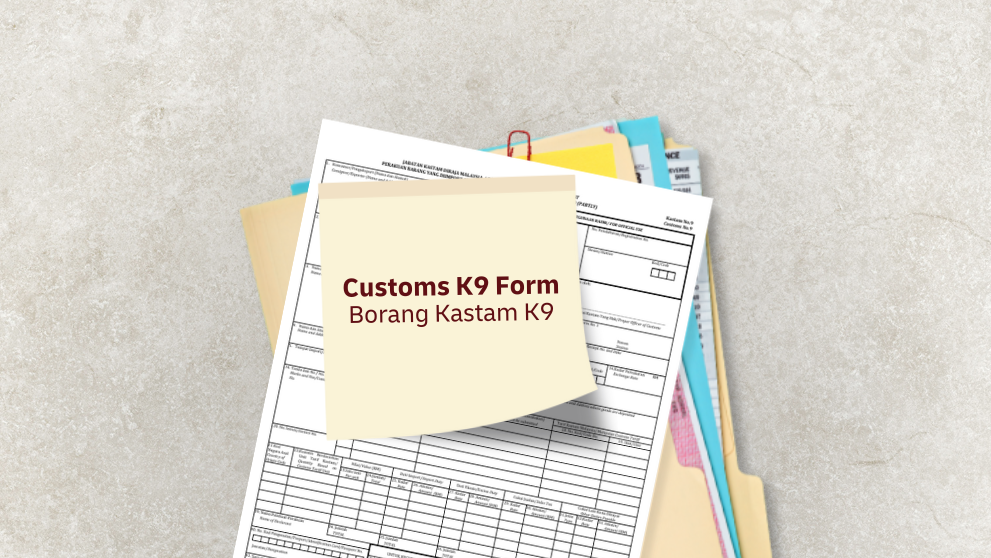
Here’s what a K1 form looks like:
What types of shipments required a K1 form
There are two types of shipments that need a K1 form.
- Imports from overseas: Goods shipped directly from other countries into Malaysia, including those arriving at Free Trade Zones (FTZ) or Licensed Manufacturing Warehouses (LMW).
- Transfers from Free Trade Zones (FTZ) and Duty-Free Islands: Goods from FTZs and Duty-Free Islands, which are Labuan, Langkawi, Tioman, and Pangkor, are treated as imports because these areas are considered outside the regular customs territory of Malaysia, which is known as the Principal Customs Areas (PCA).
For a clearer understanding, here are some examples of transfers:
- Goods moving from an FTZ to a Licensed Manufacturing Warehouse (LMW).
- Goods moving from an FTZ to the Principal Customs Area (PCA)
- Goods transported from duty-free islands (Labuan, Langkawi, Tioman, Pangkor) to PCA.
When is the K1 Form required
Importers or their agents must submit the K1 declaration form to the customs officer at the location where the goods are being imported.
| Types of Goods | Timeframe | Additional Notes |
| Dutiable Goods |
| Customs officials can require the declaration to be submitted within 3 days if they issue a notice. |
| Non-Dutiable Goods transported by sea and air | Within 10 days of arrival. | No delivery is allowed until customs approval is granted. |
| Non-Dutiable Goods transported by rail and road | Upon arrival. | No delivery is allowed until customs approval is granted. |
What is K2 Form
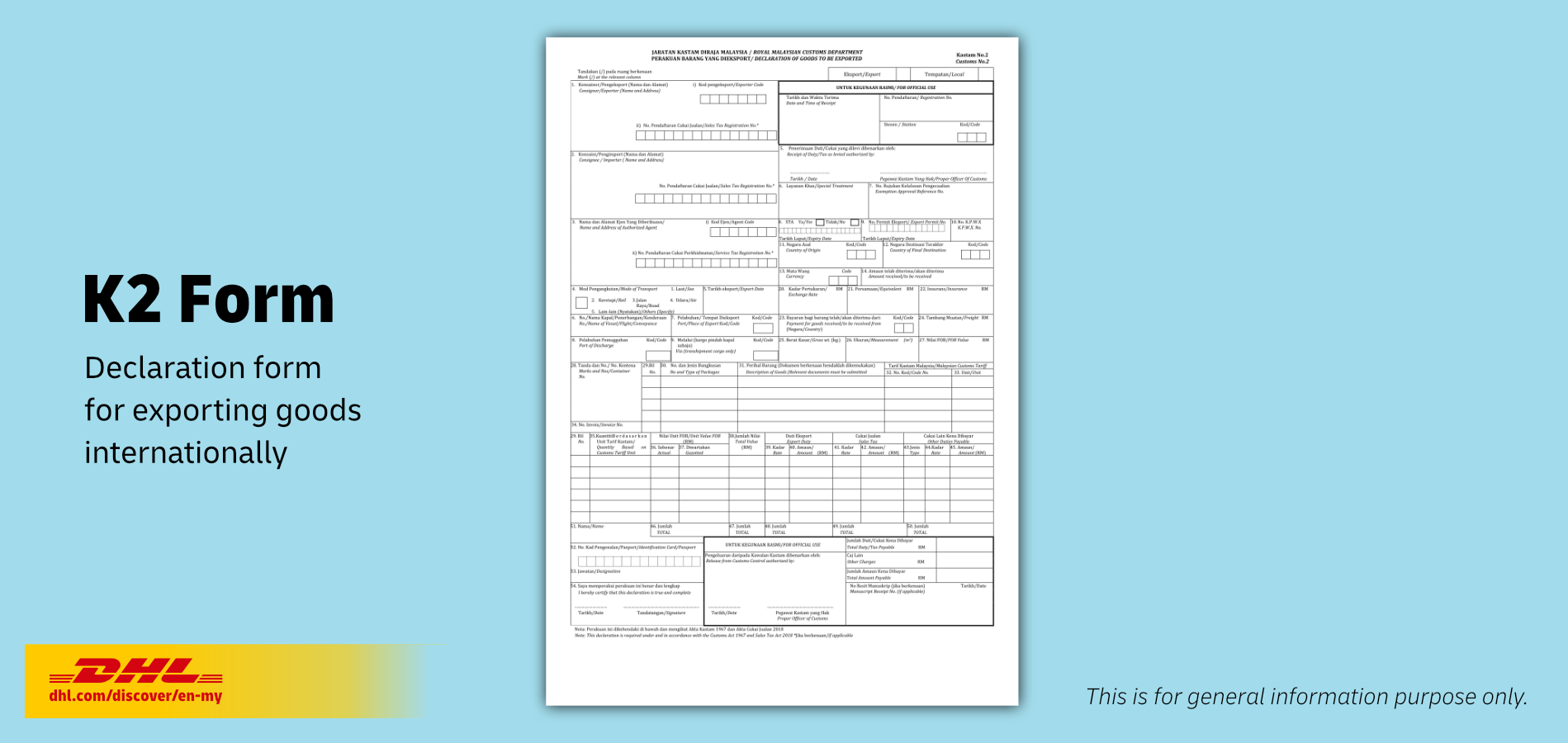
The K2 form is a mandatory customs declaration document required by the Malaysian customs authority, RMCD for the export of goods to ensure adherence to trade agreements, limitations, and demands set forth by the destination country.
This is how a K2 form look like:
What types of shipments required a K2 form
There are three types of shipments that need a K2 form.
Exports to overseas: Goods shipped directly to other countries from Malaysia, including those leaving from Licensed Manufacturing Warehouses (LMW).
Transfers to Free Trade Zones (FTZ) and Duty-Free Islands: Goods sent to FTZs and Duty-Free Islands, which are Labuan, Langkawi, Tioman, and Pangkor, are considered exports because these areas are outside the regular customs territory of Malaysia. The Principal Customs Areas (PCA) refer to other areas of Malaysia, excluding the Free Zones and Duty-Free Islands.
For clearer understanding, here are some examples of transfers:
Goods moved from an LMW to an FTZ or a Bonded Warehouse.
Goods moved from a PCA to an FTZ or a duty-free island.
Transit of Goods from Inland Clearance Depot for Export: Goods loaded for export at an inland clearance depot or customs station and transported by road or rail to the customs port or airport.
When is the K2 form required
Exporters or their agents are required to submit the K2 declaration form before the goods are shipped or loaded for export.
The customs officer at the place of export is responsible for reviewing your declaration and approving the removal of the goods from customs control before they can be transported to the destination.
How to Prepare a K1 or K2 Form
To submit either of these two forms, you must work with a registered Customs agent, like DHL Express, who is authorised to make declarations through the Customs declaration portal.
You will need to include the necessary information and documents:
- A commercial invoice that details the goods being shipped.
- Proof of payment confirming that any applicable duties or taxes have been paid.
- A permit or approval from the relevant agency if the goods being transported require such authorisation.
- Any additional documentation that the Customs officer may request.
That said, before anything else, you’ll need to identify the HS code for your goods. It is required in almost all shipping paperwork, including mandatory documents like the commercial invoice and special permits such as SIRIM approval.
To determine the correct Malaysian HS code, you can use JKDM Explorer. If you also need the HS code of other country or region, such as the United States or ASEAN, look it up on DHL Free Customs Tools.
What to do if customs asks you for a K1 form
If you've received a parcel notification from DHL, Pos Malaysia, or another courier asking you to "provide information for the K1" or "submit documents for customs clearance", they are gathering what they need to prepare the K1 on your behalf. Here is what to send and why.
For most personal and commercial shipments, you'll be asked for:
- Commercial invoice or purchase receipt: Shows the true value, currency, description, and quantity of goods. For online orders, the order confirmation or a screenshot of the checkout page is usually accepted.
- Proof of payment: Bank transfer slip, credit card statement excerpt, or payment gateway confirmation. This corroborates the declared value.
- Packing list: For shipments with multiple items or mixed SKUs.
- HS code (if known): Couriers will classify it for you if you don't provide one, but giving the correct code up-front reduces clearance time. You can look up Malaysian HS codes via JKDM Explorer.
- Permits or approvals: Only for controlled items. The most common is SIRIM approval for communication devices such as phones, routers, and wireless accessories.
- Identity details: NRIC for individuals or SSM/business registration for companies.
Respond to the courier's email with all requested documents attached. The faster you respond, the faster clearance completes — shipments held pending information cannot be released until the K1 is filed and approved.
Is the K1 form itself a tax?
No. The K1 is a declaration document, not a tax. When a shipment is cleared, three distinct charges can appear on your invoice, and it helps to keep them separate:
- Import duty: A percentage of the declared value, set by the HS code of the goods.
- Sales and Service Tax (SST): Currently applied on top of duty for most dutiable imports.
- Customs clearance / processing fee: Charged by the courier or forwarder for preparing and submitting the K1 and handling the shipment through customs. This is the courier's service fee, not a government charge.
If the total you're being asked to pay looks higher than expected, ask your courier for a breakdown of the K1 and the fee structure. A legitimate K1 will show the HS code, the declared value, and the exact duty and SST amounts.
What happens if a K1 is filed with incorrect information
Because the K1 drives the duty calculation, errors on it change what you pay. The most common issues are:
- Wrong HS code: The goods are classified under the wrong tariff line, producing a higher or lower duty rate than it should.
- Undervaluation: The declared value is lower than the true transaction value. Customs may reject it and reassess based on market price.
- Incomplete description: Vague descriptions like "gift" or "sample" are not accepted; the declaration must reflect the actual commercial nature of the goods.
If you spot an error on a K1 that has already been submitted, raise it with your courier or forwarder as soon as possible. The customs officer has the authority to amend or cancel a K1, but amendments must go through your customs agent. You cannot change a K1 yourself.
For disputes over duty assessment, the Pengarah Kastam (customs director) at the relevant station is the point of escalation.
Note that deliberate misdeclaration such as understating value, misrepresenting goods, or omitting items is treated as a customs offence under the Customs Act 1967 and can result in fines or seizure.
Keeping your K1 form for business records
Beyond clearance, the K1 is also a business document. For importers, it is the official proof that duty and SST have been paid on goods brought into Malaysia, and you should retain it for:
- LHDN tax filings: The K1 supports the cost-of-goods-sold claim for imported inventory. Without it, proving import cost relies on supplier invoices and payment records alone, which can be queried during an audit.
- SST reporting: The K1 shows the SST paid at the point of import, which may be relevant depending on your registration status.
- E-invoicing (MyInvois): For self-billed e-invoices on imported goods, the item-level breakdown on your K1 supports the detail your e-invoice needs to show. The K1 total alone is not a substitute for the per-item breakdown MyInvois requires.
Always ask your courier or forwarder for a copy of the finalised K1 after clearance. DHL Express provides the K1 document as part of the clearance paper trail on request.
Who prepares and submits the K1 form?
Only a registered customs agent or forwarding agent licensed by the Royal Malaysian Customs Department can submit a K1 or K2 declaration through the official customs portal. As the importer or exporter, you are legally responsible for the accuracy of the declaration, but you do not file it yourself.
In practice, this means:
- If you ship with DHL Express or another international courier: the courier's in-house customs team prepares and submits the K1 on your behalf, based on the information you provide when booking the shipment. You do not need to access the customs portal at any point.
- If you use a freight forwarder for sea or air freight: the forwarder's customs broker files the K1 using the commercial invoice, packing list, and bill of lading you provide.
- If you import via Pos Malaysia for a personal parcel: Pos Malaysia acts as the customs agent. For shipments that need a K1 beyond the simplified postal declaration, Pos Malaysia may ask you to provide supporting documents. But Pos Malaysia (not you) makes the submission.
- If you are an individual or business without a courier or forwarder: you will need to appoint a licensed customs agent. Customs will not fill out the form for you, and you cannot submit one directly without agent credentials.
The customs officer reviews the submitted K1 and either approves it, queries it, or amends it before the goods are released.
Quick reference: K-forms at a glance
Malaysia uses a series of customs declaration forms for different stages of goods movement. K1 and K2 are the two most common, but they are part of a broader family:
| Form | Purpose | When it applies |
| K1 | Import declaration | Goods entering Malaysia, or moving from FTZ/LMW/duty-free islands into the Principal Customs Area |
| K2 | Export declaration | Goods leaving Malaysia, or moving from PCA to FTZ/LMW/duty-free islands |
| K3 | Inter-state movement of duty-paid goods | Duty-paid goods moving between Peninsular Malaysia and East Malaysia |
| K8 | Bonded / in-transit movement | Duty-unpaid goods moving under customs control (e.g. between bonded warehouses) |
| K9 | Release of dutiable goods from bonded warehouse | Taking goods out of a licensed/bonded warehouse into the local market |
For deeper coverage of each of the other forms, see our guides on K3, K8, and K9.
Customs Declarations with DHL Express
When shipping with DHL Express, there's no need for you to prepare your own K1 form or K2 form. Whether for import or export, we'll take care of the customs declarations for you.
Thus, it's important to provide accurate information during booking, as they will be used to prepare your customs declarations forms.
In cases where we need clarification or more information, our customs officers will reach out, usually via email.


 Share
Share
Similar Stories