The K9 Form, or Borang Kastam K9, is a customs declaration form used in Malaysia for the partial importation of goods. This form is required by the Royal Malaysian Customs Department (RMCD) to help with the gradual clearance of dutiable items stored in bonded warehouses.
This guide is intended for LMW licensees, customs brokers, and SMEs handling the movement of goods between a Licensed Manufacturing Warehouse (LMW) and the Principal Customs Area, as well as the partial removal of goods from bonded warehouses.
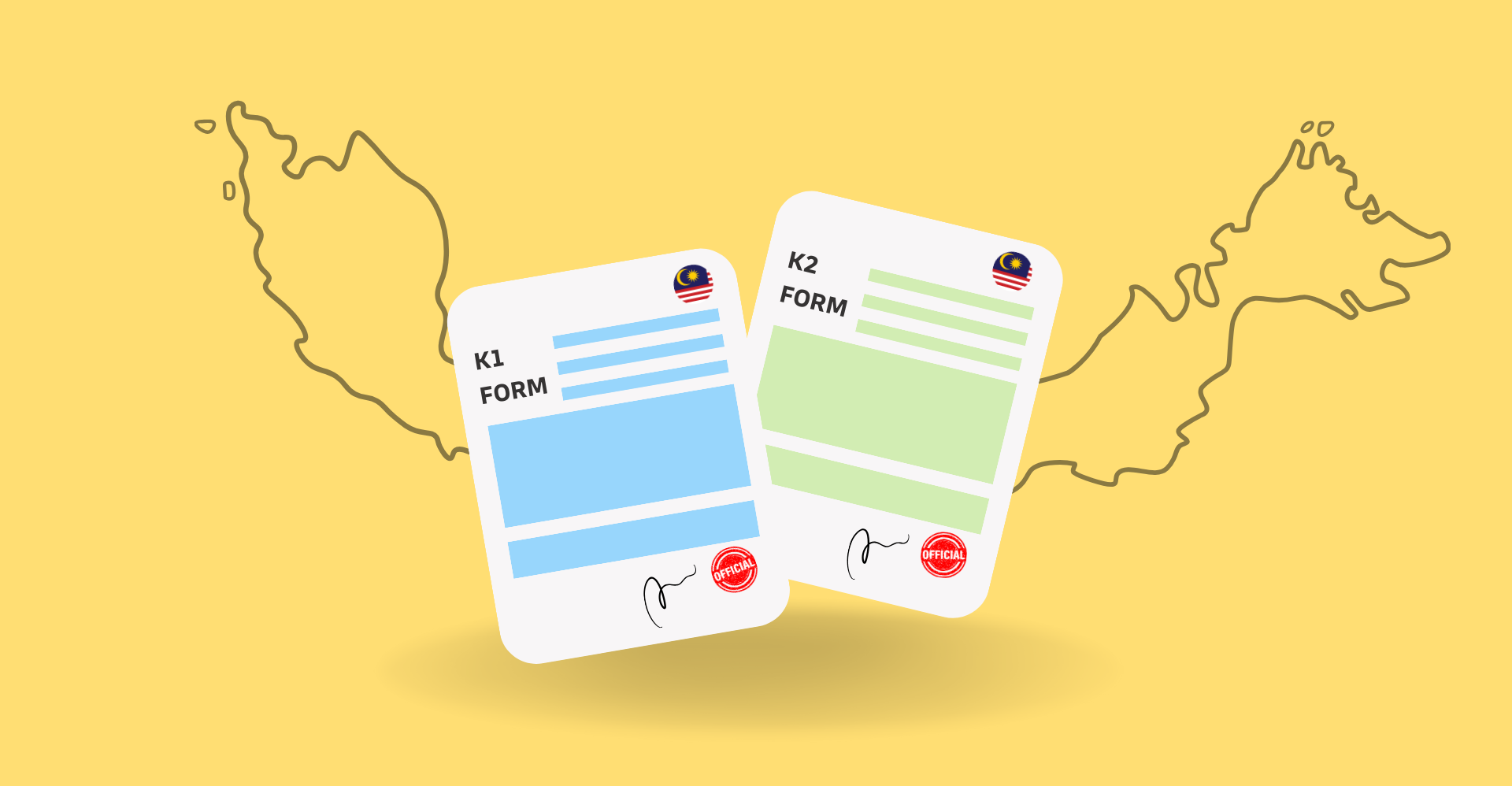
Do no confuse K9 form with other customs declaration forms in Malaysia, including K1, K2, K3, and K8. Each of these forms has its own unique purpose in the customs process, ensuring that goods are declared and cleared according to the regulations.
What is a K9 Form
The Malaysian Customs K9 Form is a declaration document used when goods are being removed from customs-controlled environments, such as Licensed Manufacturing Warehouses (LMWs), for approved movement or use within Malaysia.
This form is especially important for businesses operating under customs exemptions or tax relief schemes, as it ensures traceability and compliance when goods are moved into areas where duties or taxes may apply.
The K9 form serves two main purposes:
Partial Removal for Home Consumption
The K9 form allows the owner to remove a portion of goods from customs control - for example, from a bonded warehouse - for local use. The owner or their agent must submit the K9 form to the customs officer.
If the owner wishes to remove all the goods, they must use the K1 Form instead.
Goods movement from Licensed Manufacturing Warehouses (LMW) to Principal Customs Area (PCA)
The K9 Form covers domestic movement between an LMW and the Principal Customs Area (PCA) in both directions:
- Licensed Manufacturing Warehouse (LMW) to Principal Customs Area (PCA): finished goods sold locally, goods sent to a PCA subcontractor, scrap or waste disposal.
- Principal Customs Area (PCA) to Licensed Manufacturing Warehouse (LMW): domestically sourced raw materials or components entering the LMW, and returned subcontract work.
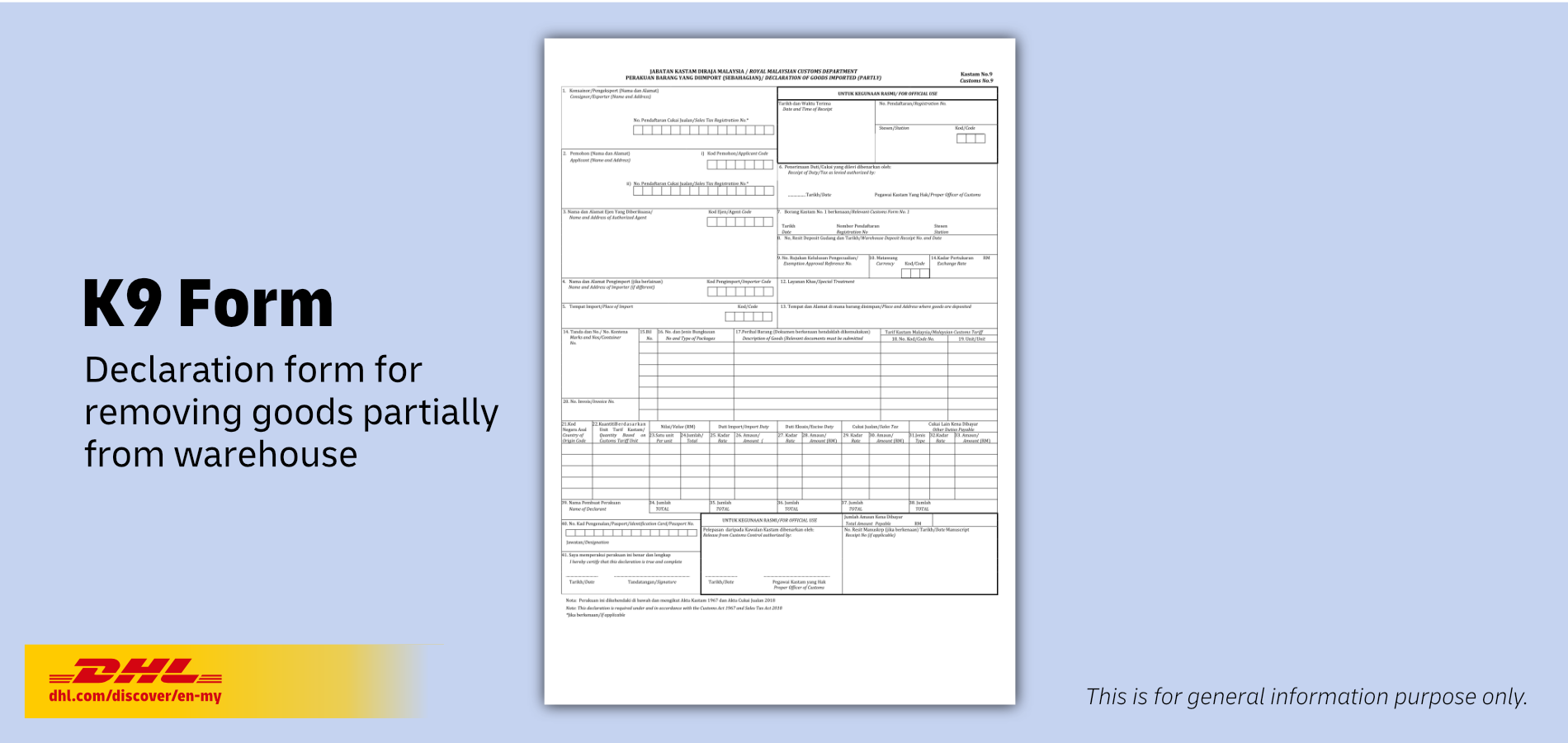
Here's how a K9 form looks like:
How K9 compares to K1, K2, K3, and K8
| Form | Purpose | Who files it |
| K1 | Imports from overseas, or transfers from a Free Trade Zone or duty-free island into the PCA | Importer or customs agent (DHL Express handles K1 for express shipments) |
| K2 | Exports overseas, or transfers from PCA/LMW to an FTZ or duty-free island | Exporter or customs agent (DHL Express handles K2 for express shipments) |
| K3 | Intra-Malaysia movement of duty-paid goods between Peninsular Malaysia, Sabah, Sarawak, and Labuan | Shipper or customs agent (DHL Express handles K3) |
| K8 | Transit through Malaysia, transhipment between modes, or partial removal of in-transit goods from customs control | Freight forwarder or bonded-area operator |
| K9 | Movement LMW and PCA (subcontract, local sales, scrap), or partial removal from a bonded warehouse | LMW licensee or warehouse operator (DHL Express does not file K9) |
When is the K9 Form required
The K9 must be submitted before the goods move, not after. The customs officer at the station of departure reviews the declaration and approves the movement before goods leave customs control or enter LMW premises.
| Movement | Submission Timeline | Notes |
| Finished goods leaving an LMW for local sale (LMW to PCA) | Before goods leave the LMW premises | Import duty, SST, and/or excise becomes payable on removal. Customs may inspect the goods before approval. |
| Domestically sourced goods entering an LMW (PCA to LMW) | Before goods enter the LMW premises | Covers raw materials or components procured from PCA suppliers but subject to LMW inventory controls. |
| Subcontract work going out to a PCA contractor | Before goods leave the LMW | A companion approval (commonly referenced as GPB1) may be required depending on the subcontract arrangement. |
| Subcontract work returning to the LMW | Before re-entry to the LMW | The return leg is declared separately. Track the companion approval to close the loop. |
| Partial removal from a bonded warehouse for home use | Before goods leave bonded storage | For removal of all goods at once, file K1 instead. |
Moving goods without a filed K9 when one is required is treated as a customs offence under the Customs Act 1967, and can result in fines, seizure, or, in the case of LMW licensees, licence suspension.
If you discover that a K9 was missed on a movement that has already occurred, contact your customs agent or the State Director of Customs to rectify as soon as possible.
Common K9 scenarios
The two most frequent real-world K9 use cases for LMW licensees are subcontract work and local market sales.
The sections below cover the K9 declaration workflow for each, including who files what, when, and with which supporting documents.
For the broader LMW operating rules (eligibility, 20% local-sales cap, MIDA approval, approved activities), refer to the LMW guide for more information.
K9 for subcontract work: Movement between LMW and PCA
LMW licensees often send partially manufactured goods to a subcontractor in the Principal Customs Area for processing such as plating, heat treatment, testing, or specialised assembly that isn't performed in-house. Because the goods are leaving the customs-controlled LMW environment, both the outbound movement and the return movement must be declared on K9.
The typical declaration sequence:
- Obtain subcontract approval from the State Director of Customs for the subcontractor relationship (one-time approval per subcontractor, supported by the relevant companion form).
- File a K9 (outbound) declaration before the goods leave the LMW, noting the subcontractor's address and the scope of work.
- The subcontractor performs the work. Goods remain subject to customs monitoring throughout.
- File a K9 (return) declaration before the processed goods re-enter the LMW.
- Reconcile the movement in the LMW's monthly returns to close the loop.
For the rules on which subcontract activities are permitted and which require additional approvals, see the LMW guide.
Refer to the official Malaysian Customs subcontracting guide for detailed requirements.
K9 for local market sales from an LMW
When an LMW sells finished goods domestically rather than exporting them, K9 is the form that brings the goods out of customs control and onto the local market. At the moment of removal, the goods are treated as imported for the first time, and duty, SST, and any excise become payable.
The typical declaration sequence:
- Confirm the sale falls within the local-sales allowance applicable to your LMW. Sales above the standard threshold require special approval from MIDA - see the LMW guide for the rules.
- Calculate the applicable import duty, SST, and excise using the HS code of the finished goods.
- Arrange payment of the duty and tax. The K9 cannot be approved until customs has proof of payment.
- File the K9 declaration before the goods leave the LMW, including the commercial invoice, proof of duty/tax payment, and any required permits.
- The customs officer approves the movement and the goods are released to the buyer.
Because the tax liability crystallises on K9 submission, many LMW licensees batch local-sale movements to align with their monthly reporting cycles.
Refer to the official Malaysian Customs guide on local sales for detailed requirements.
How to Prepare for a K9 form Submission
To submit a K9 form, you must work with a registered Customs agent who is authorized to make declarations through the Customs declaration portal.
You will need to include the necessary information and documents:
- A commercial invoice that details the goods being shipped.
- Proof of payment confirming that any applicable duties or taxes have been paid.
- A permit or approval from the relevant agency if the goods being transported require such authorization.
- Any additional documentation that the Customs officer may request.
Cost and fees associated with K9
K9 costs come from three separate sources and should be budgeted individually:
- Customs agent fee. A registered agent must file on your behalf through the Customs declaration portal. Agent fees vary by firm and by shipment complexity; expect a per-declaration charge plus any disbursement handling.
- Import duty, SST, and excise. These are not K9 fees per se, but become payable at the moment of removal for local-sales K9s and for partial removals from bonded storage. The rate depends on the HS code of the goods and the applicable Sales Tax or Excise Duty order.
- System and processing charges. Nominal charges apply at the filing stage through the customs declaration system.
K9s filed late, or filed to rectify an unreported movement that has already happened, may incur additional compound fees at the discretion of the State Director of Customs. Accuracy and timeliness matter.
Where the K9 is actually filed
K9 declarations are submitted electronically through Malaysia's National Single Window, the customs e-declaration system operated by Dagang Net (Sistem Maklumat Kastam, or SMK). Only registered customs agents and approved LMW in-house declarants have filing credentials.
If you do not have in-house capability, you must work through an appointed agent.
The same system processes K1, K2, K3, K8, and K9, so a customs agent who already files your K1 or K2 declarations is very likely equipped to handle K9 as well.
Customs Declarations Made Easy with DHL Express
When you ship with DHL Express, you can trust us to manage your shipment efficiently from start to finish.
While we handle most customs declarations for you, it's important to note that K9 declarations for shipments from the Licensed Manufacturing Warehouse (LMW) are the licensee’s responsibility.
Although the K9 form falls outside the core scope of DHL Express services, as a division of the DHL Group, a global leader in logistics, we’re connected to a wider logistics network, including our sister companies focused on other specialised services. Combined with our close working relationship with Malaysian Customs, this enables us to offer valuable guidance when needed.
Hence, if you hold a DHL Express business account for international shipping, you can always consult your account manager for assistance with all required customs paperwork, including the K9 form.


 Share
Share
Similar Stories